.

PROTON Green Mobility Challenge 2012

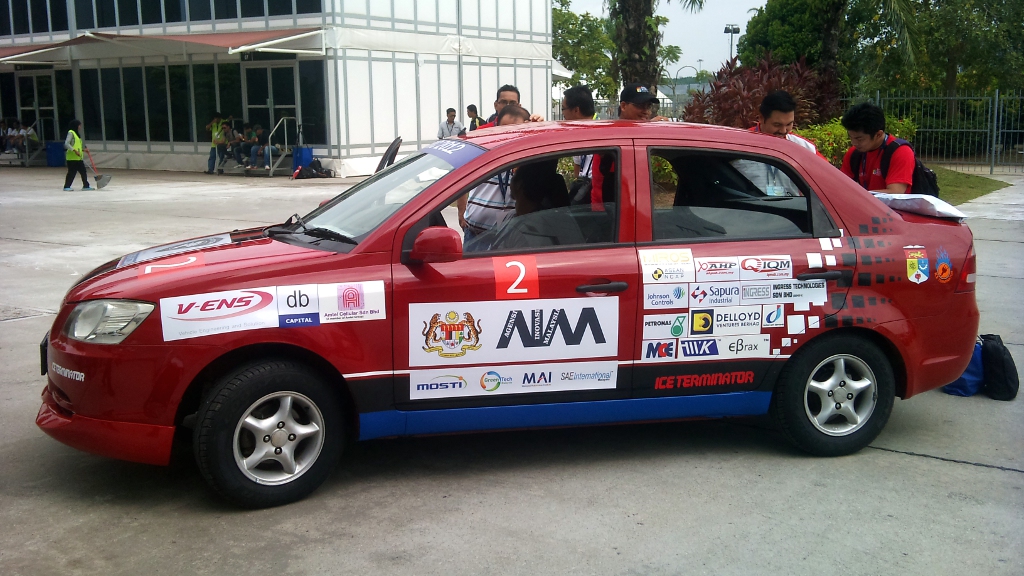
PGMC2012 is an initiative of PROTON, together with Agensi Inovasi Malaysia, to promote electric vehicles. Teams compete to build the best performing EV based on a standard 2nd generation Proton Saga.

Day 2: Fastest Time & V-Max

In the afternoon, two challenges were held together: Challenge 2: Fastest Time for 2 Laps and Challenge 3: V-Max

Day 2: Pit Walk

In between Challenge 1 and Challenge 2 & 3, the organisers provided some time for a pit walk session. Spectators are allowed to go into the pits to mix with team members and look closely at the electric cars.

Day 2: Quarter Mile Acceleration

The second day is the day of 'performance' challenges. It started with the scrutinising and safety inspection of the cars. Then, Challenge 1: Quarter Mile Acceleration starts.

Day 1: Pit Display

While most of the team work on the car, some members focused on sprucing up the pit. This is because there are also prizes on team identity and pit display.

Day 1: Registration & Practice

It's October 5th, and finally, we're in SIC. The first day started with the registration and scrutinising of all 10 cars by the PGMC 2012 TC. Only four team members were allowed to be present during the inspection.

Battery Management System

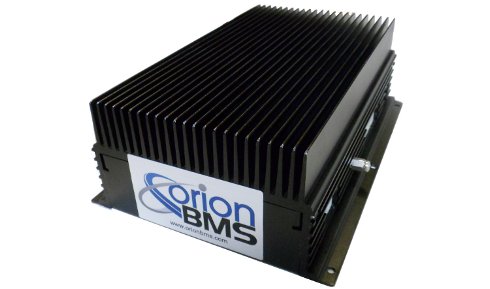
When using batteries as the power source, a battery management system (BMS) is very important. We use the Orion Li-Ion BMS.

Chargers

As an electric vehicle, the batteries used in the car has to be charged from time to time. The 12 V lead-acid car battery also has to be charged while the car is running.

Thermal Imaging

In order to get an idea of where the hottest and coolest parts of the components might be, we made use of a thermal imager.

Saga Model Incompatibility

When PROTON initially gave us the car, it was a Saga BLM 1.3 model. However for this competition, PROTON then decides to standardise the cars, based on the Saga BLM 1.6 model.

Controller Programming

The motor controller given to us was preprogrammed. To win a race however, one has to evaluate the objective of the race and tune the controller accordingly.

Track Familiarization Day

On 17 September, teams were again invited to the Sepang International Circuit, where the challenge will be held, for driver circuit familiarization.

Thermal Management

Thermal management consists of the management of heat dissipation of the motor, motor controller and lithium-ion batteries with different methods.

Test Drive

The I.C.E. Terminator EV is moving!

Completing The Circuit

With the new electric engine in place, we reconnect all the wires and install the vacuum pump. Put the tyres back on and it's system go.

Mounting

We have had some problem with adapting the transmission to fit the motor and the car. But finally, we got the parts together and mounted the new electric engine.

Battery Compartment

For the purpose of safety and thermal management, the batteries must be enclosed in some sort of compartment.

Component Assembly

The concept of ICEV to EV conversion is simple enough where the original engine is to be replaced with the electric motor provided by the organizer.

Third Progress Update

Following the previous visit, PROTON and the PGMC2012 Technical Committee visit the teams again for the third progress update. They visited us on 14 August.

In-Car Wiring

Now that the car and its electrical engine system are together in the EV Lab, the wiring of the two can be integrated together.

Sunday, 7 October 2012

Day 1: Pit Display

While most of the team work on the car, some members focused on sprucing up the pit. This is because there are also prizes on team identity and pit display.

Banner and 'evaporating ice'


Judges evaluating

Saturday, 6 October 2012

Day 1: Practice

It's October 5th, and finally, we're in Sepang International Circuit. The first day started with the registration and scrutinising of all 10 cars by the PGMC 2012 Technical Committee (TC). Only four team members were allowed to be present during the inspection. I.C.E. Terminator were represented by Wan Faizal (leader), Zulkhairi (driver), Hanief (electric) and Azhari (mechanical).

After that, teams were allowed to go to the pit area and work on their cars. All concerns raised by the TC must be addressed before teams are allowed to practice on track. Due to multiple issues, we didn't manage to solve everything until it was too late to go onto the circuit.

Besides working on the car, we also have a group focusing on the pit displays.

When all the problems have been ironed out, it's time to charge the batteries for tomorrow's events. This is also the time to finalize the strategy and tidy up the car and pit area.


Waiting for inspection

Front and back, resolving issues

Approved for testing


At the end of a long day

Friday, 5 October 2012

Battery Management System

When using batteries as the power source, a battery management system (BMS) is very important. It functions to monitor the battery pack's state, calculating and reporting secondary data, protecting the battery, controlling its environment, and balancing it. We use the Orion Li-Ion BMS.

The BMS is another problem for us. It took more than a month to arrive, and when it did, we couldn't make it work. It was only later that we realised that the BMS was broken. We ordered a replacement, and just for back-up, we designed and built a basic BMS. As luck would have it, the second BMS arrived in KLIA on Day 1 while we were in Sepang. Pos Malaysia KLIA is only 5 minutes away, though it takes an hour and half to clear the Customs. Fortunately for us, the countless hours spent previously poring over manuals were not in vain, we were able to integrate the BMS almost immediately.

BMS integration

 
The software

Thursday, 4 October 2012

Chargers

As an electric vehicle, the batteries used in the car has to be charged from time to time. The 12 V lead-acid car battery also has to be charged while the car is running. We used several types of chargers to facilitate this.

Lithium-ion battery pack charger
Lead-acid battery pack charger
12 V car battery charger
DC-to-DC converter

Wednesday, 3 October 2012

Thermal Imaging

In order to get an idea of where the hottest and coolest parts of the components might be, we made use of a thermal imager. This enables us to find the optimum placings for the cooling mechanisms.

The controller: before (left) & after (right)

The batteries: before (left) & after (right)

icelogofinale


Share

Twitter Delicious Facebook Digg Stumbleupon Favorites More